




Gamma vs X-ray Sterilization for Cleanroom Coveralls: What's the Difference?
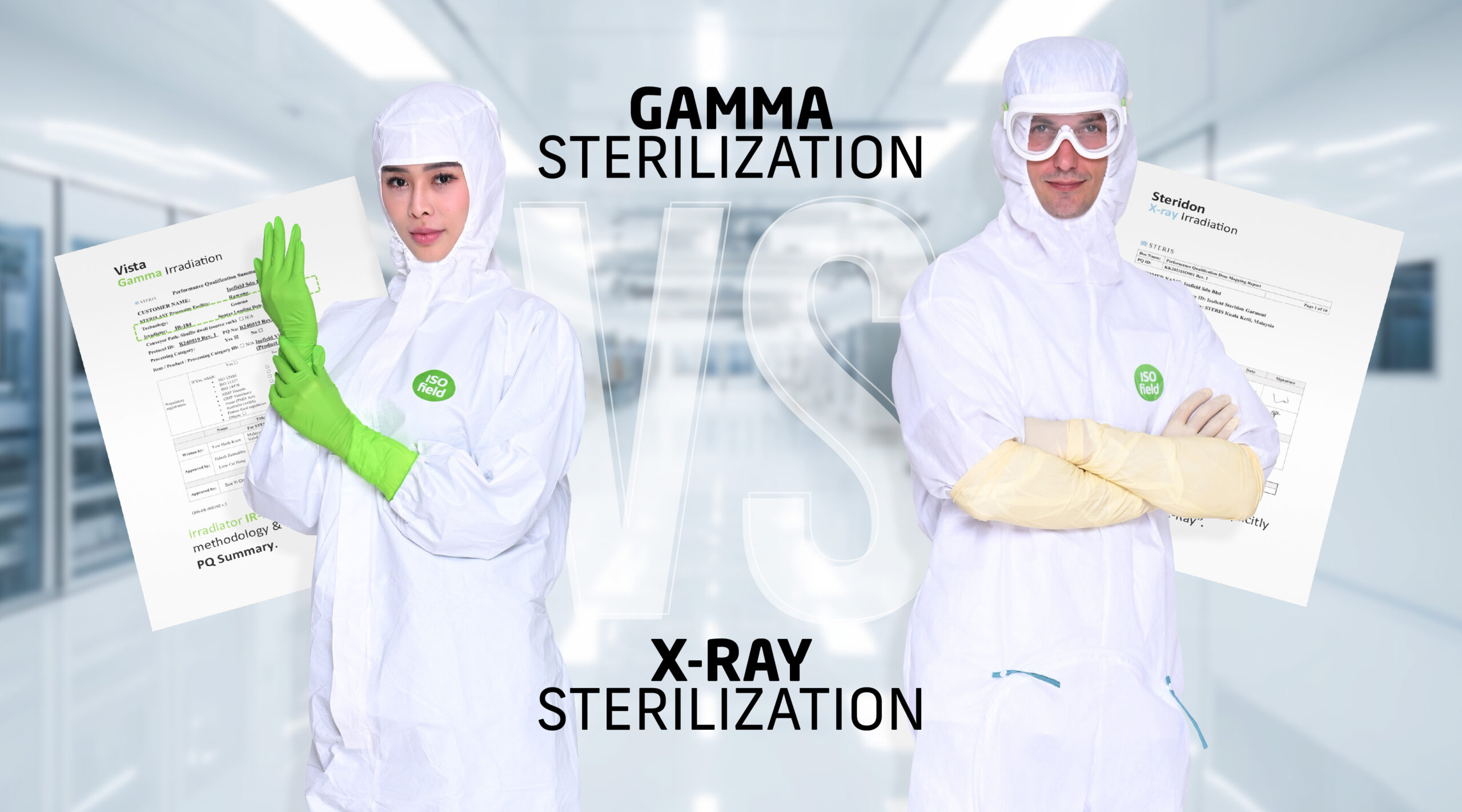
A practical guide for QA, regulatory and procurement teams qualifying sterile cleanroom garments, using Isofield Vista (gamma) & Isofield Steridon (X-Ray) as an example.
Gamma irradiation and X-ray irradiation are different ways of delivering ionising photon energy. If each finished garment has its own validated process, dose specification and routine controls, the customer reviews a very similar evidence set. The modality changes; the sterility-assurance logic does not.
Gamma is familiar, while X-ray is less familiar to many cleanroom users. That can be mistaken for a difference in assurance. For a qualified buyer, the useful question is whether the supplier has established the sterilisation dose, shown that the defined load can receive it without exceeding the maximum acceptable dose, and can prove routine control for the lot supplied. Those questions are the same for both modalities.
Two photon sources, one absorbed-dose language
Gamma irradiation uses high-energy photons released by the decay of Cobalt-60. X-ray starts with electrically accelerated electrons directed at a metal target, which converts their energy into high-energy photons. In both cases, the product absorbs ionising energy, and that absorbed dose is measured in kilograys, or kGy. STERIS describes both Gamma and X-ray as radiation processes supported by ISO 11137.
The engineering is different. A Gamma plant manages a continuously active radioisotope source and typically conveys cartons through the radiation field in carriers or totes. An X-ray plant generates photons only when the accelerator operates and can process defined pallet loads. This affects facility design, loading, capacity and logistics, but it does not create a separate definition of sterility.
The validation work is substantially the same
The common backbone is the ISO 11137 series. Part 1 covers development, validation and routine control; Part 2 covers dose establishment; and Part 3 addresses dosimetry. The current editions apply regardless of which radiation source is used.
In practical terms, both modalities require the supplier and sterilisation provider to build the same evidence chain. The product’s bioburden recovery method is validated. Representative lots are tested to estimate bioburden. A verification dose is selected and delivered within its permitted range. Irradiated samples undergo sterility testing. Once the dose is substantiated, performance qualification and dose mapping identify where the minimum and maximum doses occur within the defined load. Routine monitoring positions and release limits are then established.
This is what removes much of the perceived qualification burden. A customer changing from one already-validated sterile garment to another is not normally expected to recreate the steriliser’s microbiological validation or repeat the dose map. The supplier provides the validation pack. The customer reviews it through supplier qualification and change control, confirms suitability for the intended Grade A or B use, and integrates the garment into gowning qualification, procedures and the site’s Contamination Control Strategy.
Where a manufacturer transfers the same healthcare product between radiation sources, AAMI TIR104 provides specific guidance. That supplier-side transfer assessment is distinct from choosing between two finished garments with separate validations.
A worked example from the Isofield Steridon X-ray validation
Isofield’s Steridon validation used the VDmax25 method under ISO 11137-2. Three production batches produced an overall average bioburden of 25.1 CFU per unit. The applicable reference value was 26.0 CFU, giving a verification dose of 8.1 kGy with the permitted ±10% window. Ten samples were irradiated; the delivered dose was 7.85 to 8.11 kGy; and all ten sterility tests were negative. The study therefore substantiated 25 kGy as the minimum sterilisation dose for an SAL of 10⁻⁶.
The next question was physical dose delivery in the routine pallet configuration. The X-ray PQ mapped minimum and maximum absorbed-dose locations, established the routine monitoring position and assessed process capability. The customer specification was 25 to 40 kGy. The resulting Dose Uniformity Ratio was 1.32 against a maximum of 1.60, and the process was capable at a coverage factor of k=2. The routine monitoring release range was set at 29.4 to 35.6 kGy, with ratios linking that monitoring position to the minimum and maximum dose received by the product.
The microbiology, acceptance logic, dose units and lot-release principle will look familiar to anyone who has reviewed a Gamma validation. They are standard radiation-sterilisation controls.
Vista Sterile Coverall and Steridon Sterile Coverall: what the qualification file shows
| Validation element | Vista: Gamma | Steridon: X-ray | Qualification meaning |
| Framework | ISO 11137 radiation validation | ISO 11137 radiation validation | Same assurance framework |
| Sterilisation claim | SAL 10⁻⁶ | SAL 10⁻⁶ | Same probability-based claim |
| Customer dose specification | 25-40 kGy | 25-40 kGy | Same minimum and maximum dose window |
| Dose substantiation | ISO 11137-2; sterility tests all negative | ISO 11137-2; sterility tests all negative | Same microbiological logic |
| PQ / dose mapping | DUR 1.24; capable at k=2 | DUR 1.32; capable at k=2 | Both below the 1.60 limit |
| Routine traceability | COP linked to Isofield COA / COC | COP linked to Isofield COA / COC | Lot evidence follows the same document flow |
Source: Isofield Vista and Steridon validation records. Product-specific values shown; they should not be generalised to every Gamma or X-ray process.
What still matters to the customer
Similar validation paperwork does not make modality irrelevant or remove the need for controlled product qualification. Material and packaging compatibility must be supported at the maximum acceptable dose. Load density and configuration must match the qualified process. Shelf life and sterile-barrier integrity must be justified. A move between modalities or facilities belongs under supplier change control and the quality agreement.
At site level, the garment must still be assessed for barrier and particle performance, design, aseptic presentation, donning and operator qualification. Radiation validation shows that the packaged garment received a controlled sterilising dose. It does not qualify it for every process or operator.
The documents QA should expect to see
For either modality, a defensible file should contain the product specification and sterile claim; dose-substantiation and dose-mapping summaries; product and package compatibility across the approved range; current dose-audit status; and a lot-specific Certificate of Processing linked through the supplier’s COA or COC. The processing certificate should identify the run and confirm that dose remained inside the approved range.
Seen through a CCS lens, the flow is reassuringly familiar. Supplier validation establishes the process. Dose mapping connects the routine monitoring point to dose throughout the load. The Certificate of Processing demonstrates control of the run, and the COA or COC connects it to the garment lot received. Whether the photons came from Cobalt-60 or an accelerator does not change that traceability chain.
Common misconceptions
“X-ray is a lo wer-assurance shortcut.”
No. X-ray is covered by the same radiation-sterilisation framework. Assurance depends on the validated process and its routine control, not on how familiar the modality feels.
“A 25 kGy label is enough evidence.”
No. The important evidence is how 25 kGy was substantiated, how the maximum acceptable dose was justified, how the load was mapped and how each routine run is released.
“Changing garment modality means repeating the supplier's validation.”
Usually not when the proposed garment is already independently validated. The customer still needs formal change control and product qualification, but the heavy microbiology and dosimetry work should already exist in the supplier’s validation pack.
The practical conclusion
Gamma irradiation remains a mature, widely used and highly capable modality, and Isofield continues to use it for most of its sterile products. X-ray offers electrically generated photons and a different loading model, including qualified pallet configurations. These practical differences may influence availability, lead time, cost or supply resilience. They do not determine the level of sterility assurance.
The right question is not, “Which modality sounds safer?” It is, “Can the supplier show the validation and lot evidence?” For Vista and Steridon, that evidence is available through Isofield’s Validation Packs and lot-specific Certificate Finder. Customers can also review the Vista and Steridon product information, or contact Isofield to discuss a specific aseptic application.
“X-ray is a lower-assurance shortcut.”
No. X-ray is covered by the same radiation-sterilisation framework. Assurance depends on the validated process and its routine control, not on how familiar the modality feels.
“A 25 kGy label is enough evidence.”
No. The important evidence is how 25 kGy was substantiated, how the maximum acceptable dose was justified, how the load was mapped and how each routine run is released.
“Changing garment modality means repeating the supplier’s validation.”
Usually not when the proposed garment is already independently validated. The customer still needs formal change control and product qualification, but the heavy microbiology and dosimetry work should already exist in the supplier’s validation pack.
The practical conclusion
Gamma irradiation remains a mature, widely used and highly capable modality, and Isofield continues to use it for most of its sterile products. X-ray offers electrically generated photons and a different loading model, including qualified pallet configurations. These practical differences may influence availability, lead time, cost or supply resilience. They do not determine the level of sterility assurance.
The right question is not, “Which modality sounds safer?” It is, “Can the supplier show the validation and lot evidence?” For Vista and Steridon, that evidence is available through Isofield’s Validation Packs and lot-specific Certificate Finder. Customers can also review the Vista and Steridon product information, or contact Isofield to discuss a specific aseptic application.