




Glove Selection Under GMP: Why Sterility Alone Is Not Enough
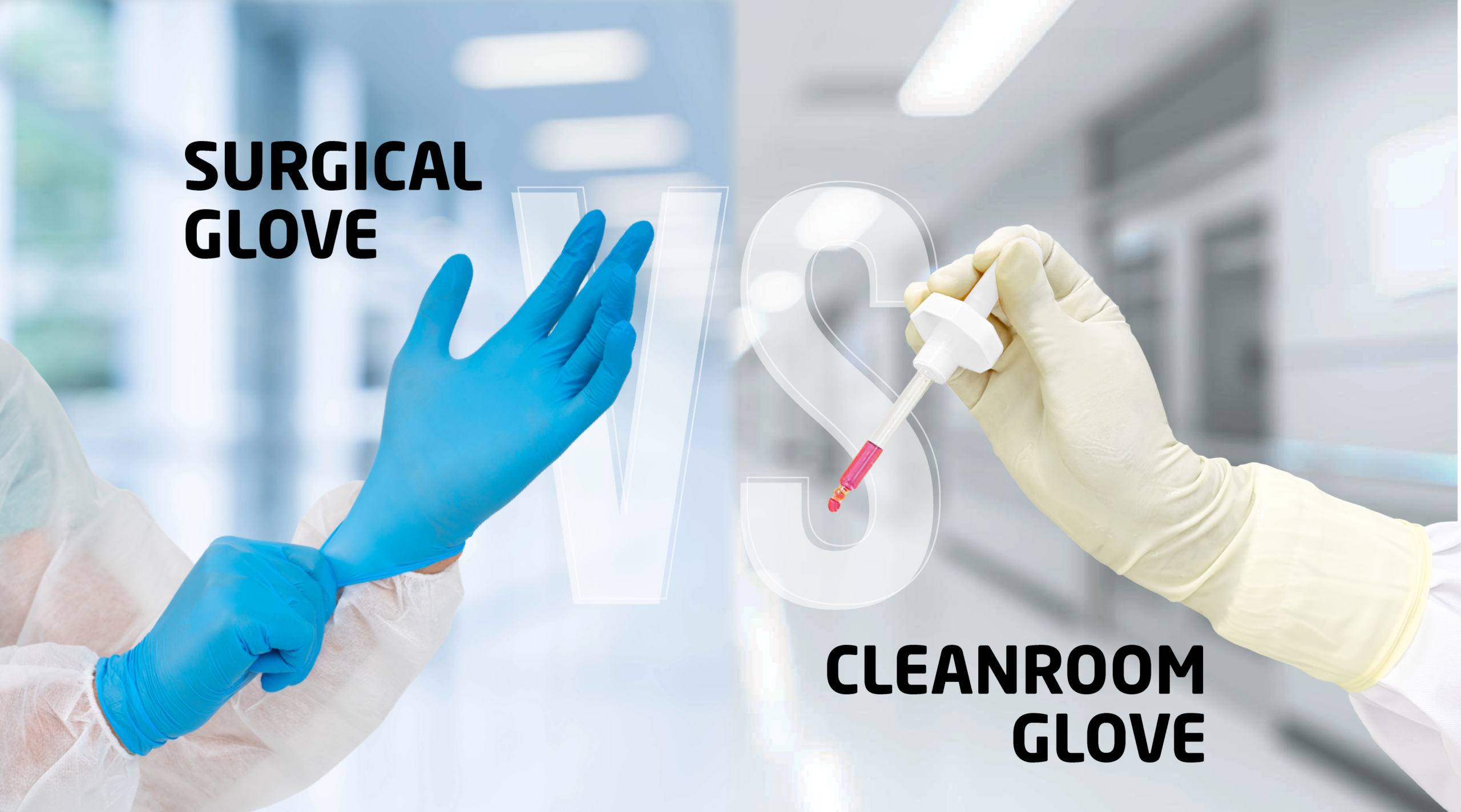
ASEPTIC CONTAMINATION CONTROL: a short version of your CCS-led approach to glove selection, qualification, and use across Grade A, B, C, and D environments
- Sterility is one attribute, not a contamination-control conclusion. Your CCS still must account for particles, extractables, ionic residues, endotoxin and what happens when the pouch is opened.
- EU GMP Annex 1 does not use the commercial term “cleanroom glove”. It instead requires the CCS to identify contamination risks and justify the control chosen for each grade. That evidence-based obligation is more important than the product label.
- The unit of qualification is the glove system, not the SKU. This includes the glove, packaging, transfer route, gown interface, use practices, and lot-specific evidence.
Sterile is not the same as cleanroom-clean
In many facilities, powder-free surgical gloves are accepted for cleanroom use because they are sterile. That confuses one verified attribute with the complete contamination-control requirement. Sterilisation addresses viable microorganisms; it does not remove particles, fibres, ionic residues or endotoxin, or demonstrate that the pouch can be opened and transferred without contaminating the gowning environment. Suitability must therefore be established for the glove, its packaging and its use in the intended process.
Medical, surgical and cleanroom describe different things
A medical glove is a broad regulatory category. Examination gloves may be sterile or non-sterile. Surgical gloves are normally sterile, hand-specific and paired for surgical use. A cleanroom glove is defined by its intended use in a contamination-controlled manufacturing environment and by the evidence supporting that use.
These categories can overlap, but the labels medical, surgical or sterile do not establish low particle release, low extractables, cleanroom packaging, validated transfer or lot evidence.
The standards make the distinction concrete. In Europe, medical gloves are commonly evidenced against the EN 455 series. International specifications include ISO 10282 for sterile surgical gloves and ISO 11193-1 for medical examination gloves. These address device performance and wearer or patient safety; they do not establish cleanroom particle release, extractable or ionic contamination, or packaging cleanliness. IEST-RP-CC005.4 supplies glove-specific test methods, while ISO 14644-18:2023 provides an intended-use assessment framework. A glove can satisfy medical-device requirements and still have no cleanroom-suitability data.
What EU GMP Annex 1 actually requires
Annex 1 does not use the commercial term “cleanroom glove”. Its language is broader and, when read in isolation, can appear vague. Paragraph 7.13 requires appropriately sterilised, non-powdered rubber or plastic gloves for Grade B, including access to or interventions into Grade A, and a second sterile pair over the garment sleeves. For Grade C and D, it states that additional gowning, including gloves, may be required for activities defined by the CCS as a contamination risk. EU GMP Annex 1
Read with the rest of Annex 1, the expectation is broader: clothing must be appropriate for the process and grade and limit shedding; items used in cleanrooms must minimise particle generation and tolerate repeated disinfection; transfer risks must be assessed and controlled; and the CCS must consider microbial, particulate and endotoxin or pyrogen contamination collectively.
Related reading: Contamination Control Strategy under EU GMP Annex 1
The practical conclusion is clear. For Grade A and B, the baseline should be a sterile, non-powdered glove supported by cleanroom-relevant processing, packaging and qualification evidence. In Grade C and D, the CCS determines whether gloves are needed and whether they must be sterile. Whenever a glove is introduced as a contamination control, its behaviour must be characterised and justified for the task.
ISO 14644 does not provide a shortcut
ISO 14644-1 classifies air cleanliness by airborne particle concentration. It does not certify gloves, and an ISO Class 5 suitability claim is not evidence of glove cleanliness. ISO 14644-1
IEST-RP-CC005.4 supplies glove-specific methods covering particle release, extractable matter, barrier integrity, tensile and cut performance, outgassing and static charge. Together they provide a defensible CCS structure: the standard frames the assessment, the recommended practice supplies methods, and the CCS justifies the acceptance criteria. Without controlled, method-linked data, a supplier has provided a brochure rather than a qualification package.
What Isofield's comparative testing shows
Isofield compared selected surgical or medical glove systems with cleanroom glove systems using three challenges. These were in-house comparisons, not independent or peer-reviewed studies. The results apply to the tested products, packaging configurations and stated conditions; they are not a universal claim for every surgical glove. Relative to the cleanroom configurations, the tested medical pouch released more than 200 times more particles during opening; the tested medical gloves released approximately 35 times more under Helmke agitation and approximately 20 times more particles at 0.5 micrometres and above in DI-water extraction.
Source: Isofield in-house comparative testing presented in A Glove System for Your CCS. Results apply to the tested products and stated conditions.
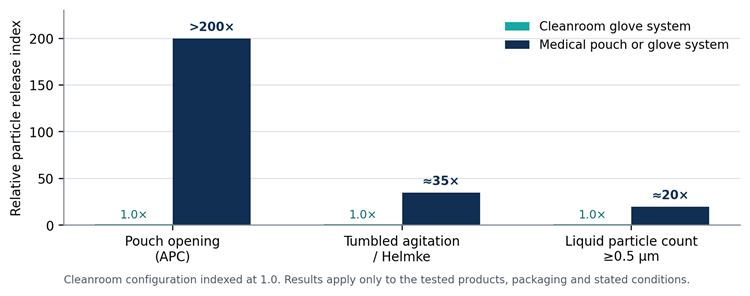
Figure 1. Relative particle release in Isofield’s in-house comparison: >200× during pouch opening, approximately 35× under Helmke agitation and approximately 20× by LPC at ≥0.5 µm. Cleanroom configurations indexed at 1.0; tested products and stated conditions only.
The packaging result matters because the pouch is the first part of the glove system to enter the transfer path. A paper peel pouch may be appropriate for a clinical sterile field yet create a particulate event when torn in a gowning room. Alcohol may reduce viable contamination on an accessible surface; it does not remove embedded fibres, prevent paper shedding or validate the opening process.
Qualify the glove system, not only the SKU
A qualification that ends with material, size, AQL and a sterility certificate is incomplete. The object entering the CCS file is the full glove system: glove, packaging, transfer route, gown interface, donning sequence, sanitisation practice, inspection regime and lifecycle evidence.
Endotoxin deserves a defined position, not a passing mention. Where a glove presents a credible transfer pathway to exposed product or product-contact surfaces, the CCS should define and justify the applicable limit, reporting unit, test method and verification frequency. Isofield’s sterile cleanroom gloves are tested to EN 455-3 using the USP bacterial endotoxins method, with a specification of no more than 20 EU per pair. This is an Isofield product specification, not a numerical limit imposed by Annex 1 on every glove. A sterility certificate says nothing about pyrogens; the risk assessment must establish whether and how endotoxin conformance is required for the intended task.
| Qualification element | Question for your site | Evidence expected |
| Intended use | Which grade, task and product exposure does the glove control? | URS, risk assessment and CCS linkage |
| Surface cleanliness | What particulate, extractable, ionic and endotoxin limits apply? | LPC or equivalent data, residue testing and, where relevant, an endotoxin specification. Isofield: ≤20 EU/pair (EN 455-3 / USP). |
| Packaging and transfer | What is opened at each grade transition and what does opening release? | Packaging specification, transfer study and opening challenge data |
| Sterility and lifecycle | How is the cycle linked to each lot and maintained through change control? | Validated process, COI/ COP or release record, supplier notification and periodic review |
| Gown interface and use | Does the cuff remain covered, and how is the glove donned, changed and inspected? | Gowning and intervention studies, approved SOP and operator qualification |
| Disinfection | Is the glove compatible with the site’s agents and wet-contact practice? | Compatibility, permeation or degradation evidence and a qualified sanitisation method |
If you are already using surgical gloves in a classified area
Most sites are not choosing a glove from scratch; a surgical glove may already be written into the SOP. Where a site identifies a qualification gap, it should document the risk, implement justified interim controls, initiate change control or CAPA and remediate to a defined schedule. This does not itself establish that the current glove is suitable or prevent an inspection observation. It demonstrates that the gap has been recognised and is being actively controlled while suitability is established.
- Assess the gap against the grade and task. Record what the current glove is not evidenced for: particle release, extractables, ionic residue, endotoxin, packaging transfer, disinfection compatibility, gown overlap and lot traceability.
- Rank by exposure. Prioritise Grade A interventions over open product paths before lower-risk Grade C or D handling tasks.
- Document interim controls. Outer-glove sanitisation, double gloving, restricted transfer, shorter change intervals and enhanced glove-print or fingertip monitoring may reduce risk, but their sufficiency must be justified for the task. Monitoring is not a substitute for suitable design.
- Obtain controlled data. Request particle-release, extractable and endotoxin evidence against identified methods. An absence of data is a qualification gap to record and act upon.
- Change-control the transition grade by grade. Convert Grade A and B first, qualify the incoming glove system through gowning and intervention studies, then reassess Grade C and D against the CCS.
- Close the loop. Update the CCS critical control points, monitoring plan and periodic review so the change remains a contamination-control decision rather than a purchasing substitution.
This sequence keeps the decision, residual risk and remediation evidence inside the CCS and change-control record.
The cost question your CCS should answer
Surgical gloves often have a lower unit price, but the decision should compare total cost: qualification evidence, investigation burden and the consequences of an environmental-monitoring excursion, glove-print or media-fill failure, inspection observation or batch rejection. Evaluate the incremental glove cost against site-specific batch value and contamination risk. If the CCS identifies the glove as a critical control point, its specification is a quality control rather than a discretionary purchasing preference.
The audit question is not: is it sterile?
FDA’s aseptic-processing guidance expects sterile gloves to be sanitised or changed appropriately and recommends routine monitoring of operators’ gloves. Australia applies PIC/S PE009-17 through TGA GMP requirements. PIC/S convergence means the same core CCS rationale is likely to face scrutiny across member inspectorates: a controlled, qualified and monitored system, not reliance on a single supplier claim. FDA aseptic processing guidance | TGA PIC/S GMP requirements
A sterile surgical glove may be suitable for surgery and still be a weak choice for a pharmaceutical cleanroom. The issue is not sterility; it is the absence of evidence for particle release, extractables, packaging transfer, disinfection compatibility, gown overlap and lot traceability in the intended process.
Our position is straightforward: any glove entering classified GMP space is part of the contamination-control system and should be specified and qualified as a cleanroom consumable. In Grade A and B that means sterile, non-powdered and cleanroom-processed, with packaging and lot evidence supporting aseptic transfer. The CCS may set sterility requirements differently in Grade C and D, but it should never accept a product label in place of cleanroom-suitability evidence.
Before approving a surgical glove for classified space, ask the supplier for controlled, current evidence: particle-release data, packaging and transfer challenges, disinfection compatibility and lot-specific certificates. If the evidence is unavailable or cannot be linked to recognised methods and the supplied configuration, the qualification gap remains unresolved. View Isofield cleanroom gloves | Access validation packs | Find lot certificates
Regulatory and technical references
European Commission – EU GMP Annex 1: Manufacture of Sterile Medicinal Products
U.S. FDA – Sterile Drug Products Produced by Aseptic Processing, Current Good Manufacturing Practice
ISO 14644-1:2015 – Classification of air cleanliness by particle concentration
TGA – PIC/S Guide to GMP PE009-17 requirements
IEST-RP-CC005.4 – Gloves and Finger Cots Used in Cleanrooms and Other Controlled Environments
ISO 14644-5 – Cleanrooms and associated controlled environments: Operations
EN 455 series – Medical gloves for single use
ISO 10282:2023 – Single-use sterile rubber surgical gloves; ISO 11193-1:2020 – Single-use medical examination gloves
USP <85> and Ph. Eur. 2.6.14 – Bacterial endotoxins test