




How are Cleanroom socks addressed under EU GMP Annex 1?
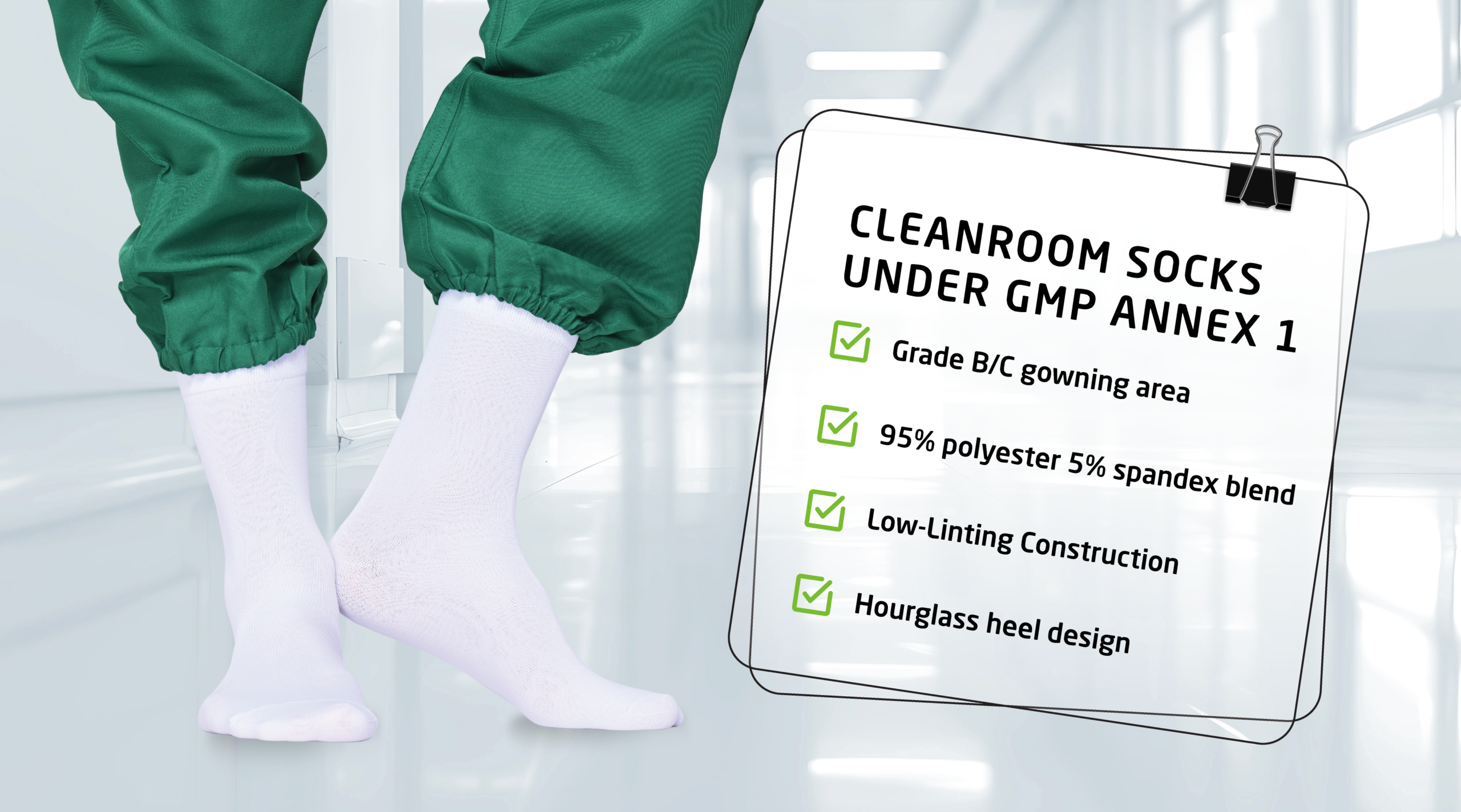
Cleanroom socks have moved from a local gowning preference to an explicit consideration under the revised EU GMP Annex 1. That does not make them equivalent to sterile gloves, masks or other controls used close to exposed product. It does mean that facilities supplying or manufacturing sterile medicinal products should be able to explain how footwear and socks are managed at the Grade B/C change-room boundary within the contamination control strategy (CCS).
For Quality and Procurement, the practical question is how to select a workable control that operators will use correctly, supported by objective supplier evidence and proportionate to process risk and budget.
What Annex 1 actually requires
Section 7.14 excludes outdoor clothing, including socks, from changing rooms leading directly to Grade B and Grade C areas. Personnel should instead wear facility suits and “facility socks covering the feet” before entry. Neither item should present a contamination risk to the gowning area or process.
Annex 1 defines an outcome and a gowning boundary, not a single-use format, specific polymer, sterile presentation or universal design. Nor does it require facility socks in every classified area. The site should define the control through quality risk management, the CCS and its gowning SOP.
Regulatory boundary: Cleanroom socks support contamination control at a defined change-room interface. They are not normally direct product-contact items, so their criticality should remain proportionate to the contamination route.
Material choice is an operator-control issue
Low linting is the starting point. Some economical, very lightweight nylon constructions provide limited moisture transport during prolonged wear. Over an eight-hour shift, heat and perspiration can become uncomfortable beneath cleanroom footwear. A sock that feels wet, twists or migrates encourages touching and adjustment during gowning or operation.
The raw polymer name alone is a poor predictor of performance. Fibre blend, yarn, knit architecture, fabric mass, stretch recovery and finishing influence moisture movement, linting and comfort. Nylon is not inherently unsuitable, nor is polyester automatically superior. A well-designed polyester/spandex construction can balance moisture management, fit and recovery.
Assessment should include a representative wearer trial covering the longest routine shift, normal footwear and the available size range. Evaluate heat and moisture perception, heel and calf movement, pressure points, donning ease and adjustment frequency. Comfort matters because operator behaviour is part of contamination control.
Other claims require separate scrutiny. ESD socks are relevant only where the process risk assessment requires electrostatic control. Likewise, “ISO Class 5 socks” is market shorthand: ISO 14644-1 classifies airborne cleanliness of environments, not socks. Ask what was tested, by which method, where the product was processed and what evidence supports its suitability.
Fit is more than a comfort feature
Many single-use cleanroom socks are simple tubes with no defined heel. This can reduce cost and simplify size management, but may allow fabric to bunch or rotate. A formed or hourglass heel can improve location on the foot. An elasticated top opening and a credible size range help retain the sock at the calf without excessive constriction.
These are design considerations, not proof of compliance. As one practical example, Isofield COS single-use cleanroom socks use a 95% polyester and 5% spandex blend, an hourglass heel, a mid-calf profile and three sizes. They are low linting and processed in an ISO Class 5 cleanroom, a statement about the processing environment, not a classification of the sock itself. Those features give a purchasing team specific attributes to assess, but qualification should still consider the site gowning system, packaging, supply continuity and actual wearer performance.
Single-use or reusable? The defensible answer is “it depends”
Reusable cleanroom socks can be appropriate where a controlled laundry service is established and the garment remains fit for purpose over qualified cycles. Annex 1 section 7.17 requires reusable clean-area clothing to be processed in a segregated laundry using a qualified process, with controls for damage, cross-contamination, inspection and maximum laundry and, where applicable, sterilisation cycles.
That infrastructure belongs in the environmental and financial calculation. A credible lifecycle comparison includes manufacture, service life, wash chemistry, water, energy, transport, packaging, losses and end-of-life treatment. Neither format is universally preferable without site-relevant data.
User acceptance also matters. Some operators object to pooled socks even after validated laundering and sanitisation. That perception is not itself a microbiological risk, but it can affect compliance. Dedicated wearer sets and traceable return may help, although they add service complexity.
Single-use socks avoid return logistics and provide a predictable new garment at issue, but create recurring consumption, waste, storage and stock-management requirements. Autoclavable socks may be justified within a particular sterile garment system, but Annex 1 does not make autoclavability or sterility the default requirement for facility socks.
Build the requirement into gowning proportionately
There is no universal instruction that cleanroom socks must be “step one”. The sequence depends on facility design and where outdoor clothing is removed. The SOP should define the boundary, issue and donning point, and prevent outdoor socks entering the Grade B/C change-room route. It should also address removal, reuse, laundry or waste flows, and dropped or damaged items.
Over the top, or change into? Annex 1 points to replacement
Annex 1 requires outdoor clothing, including socks, to remain outside changing rooms leading directly to Grade B and Grade C areas, and requires facility socks before entry. The most straightforward and defensible reading is therefore replacement rather than an added layer: an over-sock still carries the outdoor sock into the route the clause excludes.
An over-sock may be quicker and avoid barefoot contact with the change-room floor. Against that, it retains a particulate and microbial reservoir beneath the controlled garment, changes the qualified sock-footwear interface and leaves an outdoor item inside the boundary. A two-layer arrangement may still be justified where both layers are facility-issued and controlled; that is materially different from retaining an outdoor sock.
The gowning SOP should therefore answer a further set of questions:
- At which pre-change stage are personal socks removed and facility socks donned, and how is the change observed?
- How does the operator avoid contact between the uncovered or newly covered foot and the dirty-side floor?
- Where are removed personal socks stored, and what prevents them re-entering the gowning route?
- Are facility socks retained between exits and re-donned, or replaced at each entry?
- If two layers are permitted, are both facility-issued and controlled, and was footwear fit qualified in that configuration?
Where budgets are constrained, phase implementation by risk. Start with the Grade B/C routes addressed by Annex 1, trial credible options, and use wearer feedback and observation data to refine the specification. This is more defensible than imposing a costly site-wide standard without a clear boundary or deferring action because the sock is not in direct product contact.
A small garment, but a defined control
Cleanroom socks are not the most critical element of an aseptic gowning system, but they now have a defined place in Annex 1. An ill-fitting or poorly tolerated product can create avoidable interventions during gowning. Selection should balance cleanliness evidence, fabric construction, fit, shift-long comfort, wearer acceptance, service model, environmental evidence and cost.
For specification support, review Isofield’s cleanroom accessories, alongside the wider cleanroom garment, glove and facemask ranges. Supporting product documentation can be checked through the Certificate Finder. A controlled sample trial remains the best way to test whether the proposed sock performs in your facility, with your footwear and over your actual shift pattern.