




Cleanroom PPE for Sterile Injectables Manufacturing
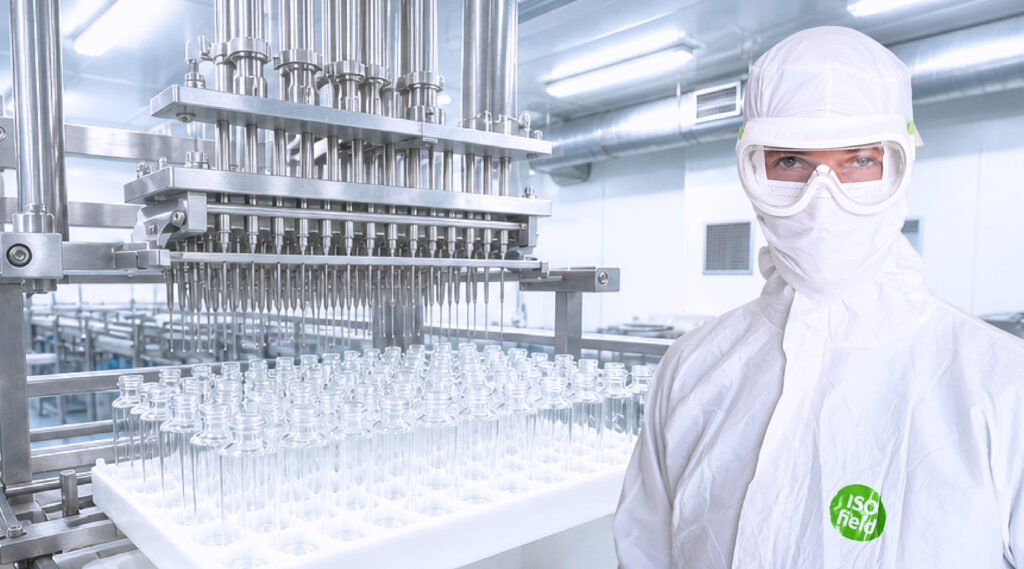
For sterile injectable manufacturers, cleanroom PPE has to protect the critical zone, support Grade A/B intervention routines and give Quality a product-and-documentation package that can move through supplier qualification without unnecessary friction
Isofield supplies sterile cleanroom gloves, garments, facemasks and goggles for Annex 1-aligned fill-finish operations, with glove lengths, garment systems, validation packs, batch-level traceability and change control protocols built into the supplier relationship.
Use this page to map Isofield product categories to sterile injectable operations: aseptic fill-finish, isolator and RABS routines, conventional cleanrooms, supplier qualification and ongoing supply support.
The sterile injectables manufacturing environment
For sterile injectable sites, the PPE decision is operational: maintain a robust sterile barrier during interventions, sanitisation and changeover without reducing operator dexterity or slowing the line.
Isofield supports isolator, RABS and conventional cleanroom operations with sterile glove, garment, facemask and goggle specifications for Grade A/B environments, plus validation documentation for supplier qualification and Contamination Control Strategy files.
EU GMP Annex 1 personnel and gowning expectations
Annex 1 matters here because it turns gowning into a documented contamination-control input. For Isofield customers, the practical impact is that gloves, garments, facemasks and goggles have to be specified together, qualified together and supported by evidence that Quality can file without rework.
Personnel entering Grade A/B areas need sterile full-body garments, sterile gloves and sterile facemasks, with protective eyewear where required. Isofield’s utility is in supplying those elements as a coherent cleanroom PPE set rather than a disconnected bundle of consumables.
Glove choice is particularly operational: length, material, AQL, tactile sensitivity and compatibility with sanitising agents all affect interventions, double-gloving and operator confidence. Isofield’s 300mm, 400mm and 600mm sterile glove options help teams match the glove to the line and gowning protocol.
Garments, facemasks and goggles matter for long shifts and repeat interventions. Disposable sterile coveralls, cleanroom facemasks and autoclavable anti-fog goggles are positioned to support both contamination control and operator usability in the Grade A/B working routine.
The supporting validation packs give Quality the sterility, endotoxin, particulate and biocompatibility evidence needed to integrate the selected PPE set into supplier qualification and CCS documentation.
PPE selection for sterile injectable manufacturing
The highest-value PPE programme for sterile injectables is one that operators can use consistently and Quality can defend during audit. The categories below show how the Isofield range maps to that requirement.
Sterile cleanroom gloves
Isofield supplies sterile cleanroom gloves in high-grade nitrile, polychloroprene (neoprene), and latex, validated for ISO Class 4 and ISO Class 5 environments. Glove lengths are available at 300mm, 400mm and 600mm to support the range of gowning protocols used across fill-finish operations, including double-gloving practices common in Grade A operations.
Selection considerations for sterile injectable manufacturing include sterility assurance level, Endotoxin reporting, Particle shedding, AQL specification, tactile sensitivity for fine manipulation work, chemical compatibility with cleaning and disinfection agents in use, and length appropriate to the gowning protocol.
Sterile cleanroom garments
The Isofield Vista and Horizon disposable garment ranges are designed for ISO Class 4 and ISO Class 5 environments. Sterile coveralls provide the full body coverage required by Annex 1 for Grade A/B operations, with attention to fabric specification, protective elements as required, particulate generation, and seam integrity.
For sterile injectable manufacturing, key considerations include sterile packaging integrity, fabric performance under operational conditions, and consistency of fit across the operator population to support the gowning qualification process.
Sterile cleanroom facemasks
Isofield sterile cleanroom facemasks are validated for sterility and designed for EU GMP Annex 1 compatibility. Unlike surgical facemasks used in healthcare settings, Isofield cleanroom facemasks are specified for the controlled-environment requirements of aseptic manufacturing.
Selection considerations include full coverage of the nose and mouth, fluid resistance, fit and seal performance, and sterility assurance documentation.
Cleanroom goggles
Isofield cleanroom goggles are autoclavable with anti-fog lenses and available in indirect and non-vented configurations to ensure EU GMP Annex 1 compliance. Configuration choice depends on the specific operation and the surrounding environment classification.
Selection considerations include compatibility with the gowning protocol, fit alongside facemasks and hoods, anti-fog performance over extended shifts, and sterilisation compatibility for reusable specifications.
Cleanroom socks and accessories
Isofield cleanroom socks are EU GMP Grade A and B compatible, single-use, low-linting, with an hourglass heel design for operator comfort during long shifts.
Why sterile injectable manufacturers choose Isofield
The value here goes beyond product availability. It’s about reducing qualification friction at the point where cleanroom PPE touches your Contamination Control Strategy, media fills, gowning qualification and routine environmental monitoring.
Full validation packs give Quality the sterility, endotoxin, particulate and biocompatibility documentation needed for supplier qualification dossiers. A Certificate Finder gives buyers direct access to current certifications, while a Change Control Notification process helps prevent supplier-driven specification changes from arriving as a production surprise.
The company operates an open-book audit policy, welcoming end-user audits at its manufacturing site annually. Production is in-house in Malaysia, with operations under one roof and a GMP-trained team across quality and operations, giving customers a direct route into supplier assurance rather than a black-box distributor model.
Stock held in Ireland, the Netherlands and Malaysia supports order flexibility during scale-up, technical transfer and demand fluctuations, without forcing customers into full-container commitments or long lead-time ordering cycles.
SEDEX membership and EcoVadis certification support the supplier ESG and ethical procurement requirements increasingly built into pharmaceutical supplier qualification processes.
Technical considerations for fill-finish PPE programmes
For fill-finish teams, cleanroom PPE has to behave predictably during qualification and routine use. Operators need dexterity, garment fit must support gowning qualification, and batch documentation must be easy to retrieve when deviation or audit questions arise.
During PPQ, aseptic process simulation or line changes, a stable PPE specification helps avoid introducing unnecessary variables. Clear validation documentation and a defined change-control process make it easier to keep PPE qualification aligned with wider aseptic process qualification, particularly relevant for Grade A cleanroom PPE programmes and aseptic gowning suppliers being assessed as part of a facility’s CCS.
Routine glove fingertip and gown monitoring generates feedback on how the gowning system performs. Where the data points to fit, glove length or change-frequency issues, specifications can be adjusted without unnecessarily widening the supplier qualification exercise.
Because supplier-driven changes can trigger internal change control, advance notification is a practical utility rather than a paperwork extra, giving Procurement and Quality time to assess specification changes before implementation.
For production planning, local stock across Europe and Asia reduces reliance on container-only supply models and helps sites manage scale-up, technical transfer and demand swings without interrupting approved PPE use.
FAQs
What grade of cleanroom is sterile injectable manufacturing carried out in?
Sterile injectable manufacturing is typically carried out with the critical zone at EU GMP Grade A, equivalent to ISO Class 5 in operation, surrounded by a Grade B background equivalent to ISO Class 7. Earlier preparation and support areas operate at Grade C and Grade D. The specific environmental classification depends on the technology in use, with isolator operations allowing lower-grade background environments than conventional fill lines.
What are the EU GMP Annex 1 gowning requirements for sterile injectables?
EU GMP Annex 1 requires sterile garments providing full body coverage, sterile gloves, sterile facemasks covering the nose and mouth, and protective eyewear for personnel entering Grade A and Grade B environments. Personnel must complete documented gowning qualification before entering classified areas, and gowning is supported by routine personnel monitoring through glove fingertip and gown contact plates. The 2022 revision of Annex 1, effective 25 August 2023, materially tightened expectations on gowning, qualification and contamination control strategy.
What is the difference between sterile and non-sterile cleanroom PPE for injectables?
Sterile cleanroom PPE has been validated to a defined Sterility Assurance Level, typically through gamma irradiation, and is supplied in sterile packaging suitable for use in Grade A and Grade B aseptic processing environments. Non-sterile cleanroom PPE is manufactured to cleanroom standards but has not undergone terminal sterilisation, and is appropriate for Grade C and Grade D environments and earlier preparation areas where sterility is not required.
Does Isofield supply PPE for isolator and RABS operations?
Yes. The Isofield product range supports the full spectrum of sterile injectable containment technologies including isolators, Restricted Access Barrier Systems (RABS) and conventional cleanroom fill operations. Each technology has different implications for gowning specification, and Isofield’s PPE range is designed to meet the requirements of all three.
Can Isofield support new fill-finish facility qualification?
Isofield supports new facility qualification through full validation packs, current certificates of conformity available via the Certificate Finder, change control documentation, and an open-book audit policy welcoming end-user audits at the manufacturing site. Speak to the Isofield team early in your facility qualification timeline to align on documentation, sample provision and supplier qualification activities.
Get in touch
Speak to the Isofield team about cleanroom PPE for sterile injectable manufacturing, request free samples for evaluation, or download the Isofield Cleanroom Product Catalogue