




Sterile Facemask Selection Under EU GMP Annex 1
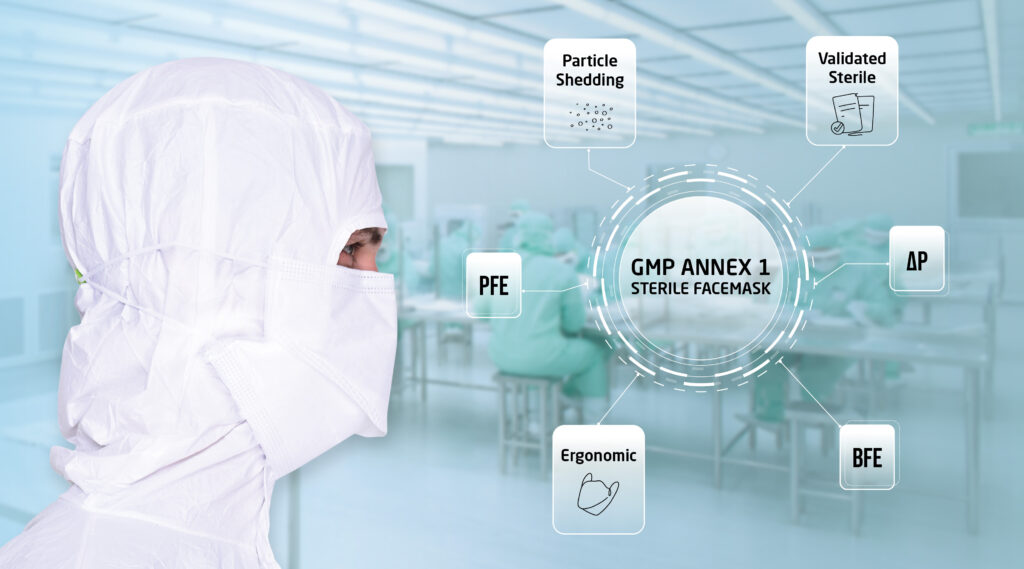
EU GMP Annex 1 Face Mask Requirements for Sterile Cleanrooms
A practical guide for procurement teams selecting sterile face masks for Grade A/B cleanrooms under EU GMP Annex 1. Learn what to validate beyond medical mask standards, including sterility validation, particle control, fit, filtration, and documentation.
Sterile manufacturing teams are under increasing pressure to justify every contamination control decision they make. Under the revised EU GMP Annex 1, that includes how operators are gowned, what risks their apparel introduces, and whether protective components such as face masks are truly suitable for aseptic environments. Annex 1 places contamination control strategy (CCS), risk management, and prevention of microbial and particulate contamination at the centre of sterile operations.
For procurement specialists, that creates a common challenge: how do you evaluate a face mask for Grade A/B use without falling into the trap of treating it like a standard medical or surgical mask purchase?
Medical face mask standards can provide useful data points, but they do not by themselves demonstrate suitability for use in a cleanroom contamination control strategy. EN 14683 is a medical face mask standard intended to limit transmission of infective agents in healthcare settings, and it explicitly is not a standard for masks intended exclusively for personal protection or a substitute for cleanroom-specific validation.
In other words, procurement for sterile cleanrooms must be driven by the CCS and the Grade A/B risk profile, not by a surgical mask datasheet alone.
Why EU GMP Annex 1 changes the procurement goalposts
EU GMP Annex 1 is not a purchasing specification, rather, a manufacturing control framework. It requires manufacturers to design and control facilities, systems, procedures, and behaviours so microbial, particulate, and endotoxin/pyrogen contamination are prevented in the final product. It also makes Quality Risk Management a minimum expectation throughout sterile manufacture.
That matters because a cleanroom face mask is not specifically PPE. In aseptic processing, it is also part of the contamination barrier between the operator and the product zone.
This is exactly the distinction your content brief highlights: PPE protects the wearer; cleanroom products protect the environment. For face masks in sterile processing, the second objective is often the more critical one.
So when procurement teams assess disposable face masks, they need to ask a stricter question:
Does this mask support contamination control in our process, or does it simply meet a healthcare product standard?
The most important mistake to avoid: sterilized is not the same as validated for sterile use
One of the biggest compliance errors is assuming that a mask is suitable for sterile use because it has been sterilized.
That is not enough.
A sterile cleanroom face mask should be supported by evidence that addresses at least three separate questions:
- Was the product sterilized by a validated process?
- Does the manufacturer carry the full validation documentation, dose mapping, and routine dose audits to back up these claims?
- Is the product itself suitable for aseptic environments from a contamination-control perspective, including particle shedding, fit, coverage, and usability?
Annex 1 expects validated and controlled processes, not just end-state claims. It emphasizes that facility, equipment, and process controls should be designed, qualified, and validated, and that contamination risks from personnel and materials must be minimized.
For procurement, that means asking suppliers for more than a certificate that says “sterile or sterilized.” You are looking for a validation package that demonstrates:
- sterilization method and validation status
- sterility assurance approach and supporting documentation
- packaging integrity
- product suitability for the intended cleanroom grade and intervention profile
- change control, traceability, and lot-level documentation where required
That aligns with your own direction to steer users toward validation evidence and interlink the validation packs page.
Medical masks vs cleanroom masks: where the standards help, and where they do not
This is the section many buyers need most.
The current EN 14683 medical mask standard covers medical face masks and their performance requirements and test methods. It includes data points such as bacterial filtration efficiency and differential pressure, and recent versions also address microbial cleanliness.
Those data points can be informative. But they should be treated as supporting characteristics, not the main compliance decision.
What medical mask data can usefully tell you
Medical face mask testing can help describe:
- BFE: how the material performs against a bacterial aerosol challenge
- PFE or sub-micron filtration, a useful indicator of filter-media performance where available under related medical mask frameworks
- DP (differential pressure): airflow resistance, often used as a breathability indicator
- microbial cleanliness / bioburden indicators: helpful but not sufficient alone, given that all Grade A/B masks should be rendered sterile. Medical / Surgical masks are not, hence the need for Bioburden reporting.
ASTM F2100 similarly classifies medical face mask material performance using BFE, differential pressure, sub-micron particulate filtration efficiency, synthetic blood penetration, and flammability, while also noting it does not address all aspects of mask design effectiveness or respiratory protection.
What medical mask data does not tell you
A surgical or medical mask test report does not automatically show:
- suitability for Grade A/B aseptic operations
- compatibility with your CCS
- particle shedding performance in cleanroom use
- full facial coverage performance in motion
- sterility maintenance after sterilization and packaging
- ergonomic suitability for long aseptic shifts
- risk of operator adjustment during critical tasks
- interaction with goggles, hoods, coveralls, and aseptic gowning systems
That is why procurement teams must not conflate medical mask, surgical mask, and cleanroom mask requirements.
What procurement teams should prioritize under EU GMP Annex 1
1) Full face coverage and containment of operator-generated contamination
A face mask used in sterile processing should help contain contamination generated from the nose, mouth, skin, and surrounding facial area.
This means procurement should look beyond a flat product photo and ask:
- Does the mask provide reliable coverage over nose, mouth, cheeks, and under-chin area?
- Does it stay in position during turning, speaking, bending, and prolonged wear?
- Does it integrate properly with goggles, hoods, coveralls, and sterile gowning?
- Does it reduce the need for readjustment, which itself introduces touch contamination risk?
For Grade A/B environments, this is not a cosmetic detail. It is part of operator contamination control.
2) Particle generation and shedding performance
Annex 1 repeatedly focuses on prevention of particulate contamination in sterile manufacture.
That means a face mask cannot be selected only for filtration efficiency. The product itself must also be assessed as a potential source of particles and fibres.
This is where cleanroom-specific evidence matters. Your brief correctly points to Helmke Drum testing as a signal of technical authority. Helmke drum methods are used to quantify particles released from garments and similar cleanroom materials during mechanical agitation, making them much more relevant to contamination control than conventional healthcare mask marketing claims.
For procurement, the practical question is:
Can the supplier show evidence that the mask material and finished construction are suitable for low-particle cleanroom use, not just that the filter media performs well in a medical test?
3) Ergonomics: ties vs earloops with clips
This is often underestimated, but it has direct compliance implications.
On paper, both ties and earloops may look acceptable. In practice, their suitability depends on the operation, shift length, and operator behaviour they drive.
Ties
- typically offer more secure and customizable fit
- can help maintain mask position during longer wear
- may better support full-face coverage consistency
- can reduce the tendency to adjust the mask during use
Earloops with clips
- may be quicker to don
- may improve comfort for some users
- can work well in lower-risk applications
- but can also create fit variability depending on head shape, hood integration, and clip tension
The right choice should be made through the CCS and operator risk assessment, not convenience alone. In Grade A/B areas, the best solution is usually the one that minimizes movement, gapping, and operator intervention.
A procurement team should therefore ask for evidence or site data on:
- fit stability over time
- compatibility with other sterile garments
- operator comfort across shift duration
- frequency of face touching or readjustment
- training implications during aseptic gowning
4) Filtration performance: BFE, PFE, and what they actually mean
BFE and PFE are useful, but only when interpreted correctly.
- BFE indicates filtration against bacterial aerosol challenge
- PFE indicates filtration against sub-micron particulate challenge
- ΔP indicates airflow resistance or breathability
These metrics can help compare products, but they are not a full cleanroom qualification package. A mask with impressive BFE or PFE may still be a poor choice for Grade A/B if it sheds particles, gaps during movement, or encourages frequent adjustment.
The right procurement approach is:
Use BFE, PFE, and ΔP as supportive data within a broader contamination-control assessment. Do not use them as stand-alone proof of Annex 1 suitability.
5) Differential pressure matters, but not in isolation
Differential pressure is often discussed as a comfort metric, and that is fair. In medical mask standards it is used as an indicator of breathability.
In sterile manufacturing, however, DP matters for a broader reason: if a mask is uncomfortable, operators are more likely to adjust it, break concentration, or wear it inconsistently. That becomes a behavioural contamination risk.
So DP should be considered in the context of:
- shift duration
- speaking frequency
- hot or high-stress operations
- compatibility with eyewear and hoods
- likelihood of face touching
Again, this is why procurement must be tied back to the CCS.
6) Sterile vs non-sterile cleanroom face masks
Your brief also asks to distinguish sterile and non-sterile cleanroom face masks.
A simple way to present this:
Sterile cleanroom masks are typically appropriate where the mask enters higher-risk sterile processes, especially where aseptic interventions or Grade A/B support activities demand the strongest control over microbial introduction.
Non-sterile cleanroom masks may be appropriate in less critical controlled environments where low particle shedding and cleanroom compatibility are required, but sterility is not mandated by the process risk assessment.
The decision should be based on:
- proximity to exposed sterile product
- cleanroom grade
- intervention type
- gowning configuration
- transfer and presentation controls
- site CCS
What an auditor will expect procurement files to show
Whether the site is inspected by EU authorities, the MHRA, FDA, TGA, or other GMP regulators, the underlying expectation is the same: the manufacturer must be able to justify that its contamination controls are appropriate, risk-based, and evidence-backed. EMA states that any manufacturer supplying medicines to the EU market must comply with EU GMP, while MHRA and TGA both operate GMP inspection frameworks that expect compliance with sterile manufacturing controls, with TGA adopting the PIC/S GMP guide that includes Annex 1 for sterile medicinal products.
So the procurement record for a cleanroom face mask should not stop at price, lead time, or a generic declaration of conformity.
It should show, clearly:
- why this product was selected for the intended grade and process
- how the CCS informed the selection
- what validation evidence was reviewed
- what cleanroom-specific test data was considered
- how sterile status and packaging integrity are assured
- how ergonomics and fit reduce behavioural contamination risk
- how supplier change control will be managed
The procurement standard should be “fit for aseptic use,” not “looks compliant on paper”
A medical mask may satisfy a healthcare standard.
A PPE face mask may help protect the wearer.
A surgical face mask may perform well in BFE and differential pressure tests.
But a cleanroom mask for Grade A/B procurement should be selected only when it supports the site’s contamination control strategy and can be defended during audit.
That means asking for documentation that demonstrates:
- validated sterility, not just sterilization
- low particle generation characteristics
- reliable full-face coverage
- compatibility with hoods and goggles
- stable fit under real use conditions
- useful filtration data interpreted in context
- documentation suitable for qualification and supplier approval
If your team is reviewing sterile face coverings for Grade A/B use, the safest procurement decision is rarely the product with the simplest datasheet. It is the one backed by the strongest validation evidence, clearest contamination-control rationale, and most appropriate cleanroom performance profile.
At Isofield, that is the standard we believe procurement teams should expect from every cleanroom face mask supplier. Explore our validation packs to review the technical documentation behind our cleanroom products, and compare sterile and non-sterile options based on the criteria that actually matter in audit-ready manufacturing environments.
Quick checklist: what to ask before approving a sterile face mask supplier
Use this as a practical procurement checklist.
EU GMP Annex 1 sterile face mask checklist
- Has the product been selected against the site’s CCS and Grade A/B risk profile?
- Do we have evidence of validated sterility assurance, not just sterilization?
- Is there documented support for packaging integrity and sterile presentation?
- Does the mask provide full face coverage with stable fit during movement?
- Is there evidence on particle generation / shedding, ideally from cleanroom-relevant methods such as Helmke-type testing?
- Have BFE, PFE, and ΔP been reviewed as supporting data rather than sole selection criteria?
- Is the fastening system, including ties or earloops with clips, appropriate for operator behaviour and aseptic gowning?
- Is the product compatible with hoods, goggles, coveralls, and the wider gowning system?
- Has the supplier provided adequate validation documentation, change control, and traceability?
- Could we defend this selection during an FDA, MHRA, TGA, or EU GMP inspection?